Charged Fluids
Charged fluids, which include ionic liquids, electrolytes, eutectic liquids, and molten salts, are governed by long-range Coulombic interactions between their constituent ions. This makes their structure, transport, and stability both scientifically rich and genuinely hard to predict. Predicting these properties well using simulations is what makes it possible to design better batteries, safer nuclear reactors, and more sustainable separation processes.
Ionic Liquids
For more than two decades, the Maginn Lab has used molecular simulation to understand ionic liquids — salts that are liquid near room temperature and are composed entirely of ions. When we began this work, very little was known about how to model these liquids or how their chemical structure set their properties. Some of our key findings are listed here.
Early Simulation and CO2 capture
An early step was establishing that the thermophysical properties of an ionic liquid could be predicted, not merely reproduced. Building an all-atom model of 1-n-butyl-3-methylimidazolium hexafluorophosphate from quantum chemistry and standard parameters, with no fitting to experimental data, the group predicted molar volumes within about one percent of experiment and introduced a picture of ion transport in which each ion is caged by its neighbors and moves by escaping that cage. Combining our simulations with the experiments of collaborator Joan Brennecke, we showed that carbon dioxide was highly soluble in ionic liquids and carried out early studies on the use of ionic liquids for CO2 capture. This work also showed that treating each ion as carrying a full +/-1 charge is not the most realistic model; the effective charge on each ion is somewhat less and accounts for polarizability in a mean field manner.
Morrow & Maginn, J. Phys. Chem. B 2002, 106, 12807; Cadena et al., J. Am. Chem. Soc. 2004, 126, 5300; 171. Ryan Gotchy Mullen, Steven Corcelli and Edward J. Maginn, “Reaction Ensemble Monte Carlo Simulations of CO2 Absorption in the Reactive Ionic Liquid Triethyl(octyl)phosphonium 2-Cyanopyrrolide”, Journal of Physical Chemistry Letters, 2018, 9, 5213-5218. DOI 10.1021/acs/jpclett.8b02304; 1. Quintin R. Sheridan, William F. Schneider and Edward J. Maginn, “Role of Molecular Modeling in the Development of CO2-Reactive Ionic Liquids”, Chemical Reviews, 2018, 118, 10 5242-5260. DOI: 10.1021/acs.chemrev.8b00017.
Vaporization of Ionic Liquids
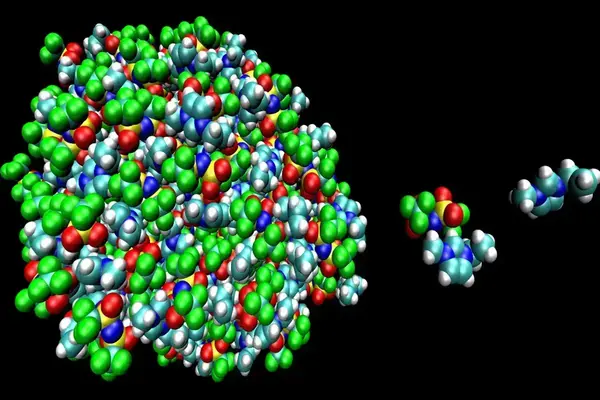
The group also used simulation to resolve what an ionic liquid's vapor actually is. On energetic grounds, the simulations established that the species leaving an ionic liquid must be a single neutral ion pair; larger neutral clusters and any charged fragment carry a far higher enthalpy of vaporization. We then worked with the experimental group of Stephen Leone at Berkeley to confirm this spectroscopically, since a claim of this kind needs experimental verification. We went further and computed vapor-liquid coexistence curves and hypothetical critical points for ionic liquids — quantities that experiment cannot reach, because these liquids decompose long before they would boil.
Kelkar & Maginn, J. Phys. Chem. B 2007, 111, 9424; Strasser, Goulay, Kelkar, Maginn, Leone, J. Phys. Chem. A 2007, 111, 3191; Rai & Maginn, Faraday Discuss. 2012 (DOI 10.1039/c1fd00090j)
Melting Points and Phase Behavior
![Cyan, blue, white ball-and-stick model of imidazolium decyl chain. Two unit cells ([C2], [C10]) show molecular arrangements.](/assets/661253/bernadino_mp_image.jpeg)
A sustained line of work used free-energy methods to explain what controls an ionic liquid's melting point. Using the pseudo-supercritical path approach, we showed why adding a methyl group at the C2 position of the imidazolium cation raises the melting point and viscosity (the effect is mainly entropic), why melting point varies non-monotonically with cation chain length, and how the flexibility of individual bonds in the alkyl chain contributes to this trend. Across these studies the simulations capture the experimental trends and, more importantly, the underlying physics; we have clearly shown that ionic liquid melting behavior is set by a competition between the enthalpy and the entropy of fusion.
Zhang & Maginn, Phys. Chem. Chem. Phys. 2012, 14, 12157; Zhang & Maginn, Phys. Chem. Chem. Phys. 2014, 16, 13489; Bernardino, Zhang, Ribeiro, Maginn, J. Chem. Phys. 2020, 153, 044504
Local Dynamics and Transport Properties
Our group established a link between the local, picosecond-scale motions in an ionic liquid and its bulk transport behavior. Across twenty-nine different ionic liquids and a wide temperature range, no simple rule of ion size or shape predicts how fast the liquid moves, but a single quantity does: the lifetime of local ion pairs and ion cages. Self-diffusivity and ionic conductivity track this lifetime through one universal relationship, and viscosity follows by a well-established inverse relationship. This insight — that collective transport is governed by local structural dynamics — directly motivated the group's later work on reliable methods for computing viscosity and transport properties (see Molecular Simulations: Methods and Software Development).
Zhang & Maginn, J. Phys. Chem. Lett. 2015, 6, 700; Zhang et al., J. Phys. Chem. B 2015, 119, 14934
More than twenty years of method development on ionic liquids is the foundation for the group's current charged-fluids research, which extends these tools to harder and more varied systems: concentrated and eutectic electrolytes for energy storage, and molten salts for advanced nuclear energy.
Electrolytes for Energy Storage
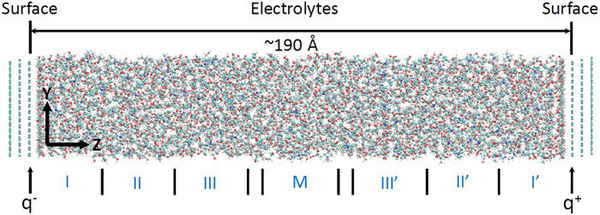
Electrolytes are central to the performance, safety, and lifetime of advanced batteries. They determine how rapidly charge-carrying ions move, how stable the electrode interfaces are, and how much active material can be dissolved or transported. In many emerging technologies, including flow batteries, aqueous lithium batteries, and “beyond lithium” systems, the electrolyte is not a passive medium but an active design variable. Our group uses molecular simulation, machine learning, and close collaboration with experimental partners to understand how electrolyte composition controls liquid structure, transport, and electrochemical performance.
Deep Eutectic Solvents
One major focus has been deep eutectic solvents, a class of liquids formed by mixing components that are often solid at room temperature but that as a mixture exhibit a depressed melting point that is below room temperature. These fluids are attractive for energy-storage applications because they can be inexpensive, nonvolatile, chemically tunable, and capable of dissolving redox-active species at high concentration. They are also complex: their properties are governed by hydrogen bonding, ion association, structural heterogeneity, and slow dynamics. We have used molecular dynamics simulations to predict the conductivity, viscosity, and microscopic structure of a range of deep eutectic solvents, including choline chloride-based systems relevant to flow batteries and electrochemical separations. In collaboration with experimental groups, this work has shown how local structural heterogeneity and molecular-scale dynamics evolve with composition, and how these microscopic features influence macroscopic transport.
More recently, we have combined simulation, high-throughput experiments, and machine learning to accelerate the discovery and characterization of deep eutectic solvents. Rather than measuring or simulating every possible composition, active-learning methods can identify the most informative experiments or calculations needed to construct phase diagrams and predict properties such as viscosity. This approach is especially valuable for eutectic systems, where small changes in composition or molecular structure can produce large changes in melting behavior, transport, and electrochemical properties. Together with our work on the melting and solid-state transitions of choline chloride, these studies connect molecular interactions to the phase behavior that determines whether a proposed electrolyte will be liquid and useful under operating conditions.
Spittle et al., Nature Communications, 2022; Zhang et al., J. Phys. Chem. B, 2022; Sinclair et al., J. Electrochem. Soc., 2025; Zhang & Maginn, J. Chem. Phys., 2025; Poe et al., J. Phys. Chem. B, 2025; Abranches, Maginn & Colón, AIChE Journal, 2023; Abranches et al., ACS Sustainable Chemistry & Engineering, 2024; Correa et al., J. Phys. Chem. Lett., 2024.
Highly Concentrated Aqueous Electrolytes
A second focus has been highly concentrated aqueous electrolytes, including water-in-salt and water-in-bisalt systems. These electrolytes challenge the usual picture of an aqueous solution: instead of ions being dilute species dissolved in water, water becomes part of an extended ion-rich network. Using molecular dynamics simulations in combination with scattering, spectroscopy, and other experimental probes, we helped elucidate the liquid structure of these concentrated electrolytes and the mechanisms by which lithium ions move through them. Our simulations showed that transport in water-in-salt electrolytes is controlled not simply by ion diffusion through a uniform solvent, but by the local coordination environment, ion pairing, and the rearrangement of the surrounding liquid structure.
Beyond Lithium Electrolytes
We have also extended this work to beyond-lithium electrolyte chemistries, including zinc and magnesium-relevant systems. These multivalent ions present additional challenges because their stronger electrostatic interactions lead to more persistent solvation structures, stronger ion pairing, and more complicated interfacial behavior. In zinc electrolytes, for example, our simulations have helped clarify whether zinc ions are coordinated primarily by water molecules or by anions in mixed water-in-salt environments, why certain solvent mixtures show unexpected maxima in ionic conductivity, and how additives such as acetonitrile influence the electrolyte structure near zinc metal anodes. These studies illustrate the broader goal of our electrolyte research: to use molecular-level insight to explain surprising experimental observations and identify design principles for safer, more efficient batteries.
Across these projects, a common theme is that electrolyte performance is controlled by structure and dynamics over many length and time scales. The local solvation shell of an ion, the lifetime of ion pairs and clusters, the presence of nanoscale heterogeneity, and the structure of the liquid near an electrode surface can all determine measurable properties such as conductivity, viscosity, charge-transfer kinetics, and battery performance. By combining molecular simulation with experiment and machine learning, we aim to turn these microscopic details into practical guidance for designing better electrolytes for advanced energy-storage technologies.
Molten Salts for Advanced Nuclear Reactors
Molten salts extend many of the same questions that arise in ionic liquids and electrolytes to much higher temperatures and more chemically demanding environments. Molten salts are central to several advanced nuclear reactor concepts, where they may serve as coolants, heat-transfer fluids, or even as liquid fuels. These salts can operate at high temperatures while remaining chemically stable and at low vapor pressure, making them attractive for safe and efficient energy systems. At the same time, their behavior is difficult to predict; molten salts are dense, highly ionic liquids in which strong Coulombic interactions, polarization effects, and complex local coordination environments determine macroscopic properties such as viscosity, diffusivity, thermal conductivity, melting behavior, and gas solubility.
Structure and Dynamics of Molten Chloride Salts
Our work has focused primarily on chloride molten salts, especially those relevant to molten salt reactor applications. A central challenge in this area is developing molecular models that are accurate enough to capture the structure and dynamics of these liquids, but efficient enough to simulate the mixtures and conditions needed for engineering design. We have compared ab initio molecular dynamics, polarizable ion models, and rigid ion models for molten alkali chlorides and related chloride mixtures, assessing how well each approach predicts structure, thermodynamics, and transport properties. These studies help define when simpler models are sufficient and when polarization or more detailed electronic-structure information is needed.
In collaboration with experimental and theoretical partners, we have used simulation together with X-ray scattering and rate theory to understand the structure and dynamics of molten alkali chloride salts. These studies connect microscopic features such as ion coordination, local structure, and dynamic rearrangement to properties such as diffusivity and viscosity. Related work on MgCl2–KCl mixtures has advanced efficient polarizable models for multicomponent chloride salts, an important step toward realistic simulations of chemically complex reactor-relevant fluids.
Roy et al., Physical Chemistry Chemical Physics, 2020; Wang et al., Journal of Chemical Physics, 2020; Sharma et al., Journal of Physical Chemistry A, 2020.
Phase Behavior and Melting Points
A second theme is the prediction of phase behavior and melting properties. For molten salt technologies, knowing when a mixture will melt, crystallize, or remain liquid is essential for selecting operating windows and avoiding undesirable solid formation. We have developed and applied direct simulation and alchemical free-energy methods to compute the liquidus of binary monatomic salt mixtures. This work extends our broader expertise in free-energy methods and melting-point prediction to the high-temperature ionic fluids relevant to nuclear energy.
DeFever & Maginn, Journal of Physical Chemistry A, 2021.
Gas Solubility
We have also studied gas solubility in molten salts, including the solubility of noble gases such as argon and xenon in molten sodium chloride and potassium chloride. Gas solubility is important because fission gases, cover gases, and dissolved species can influence reactor operation, materials compatibility, and separation processes. By computing how gases dissolve in molten salts and how solubility depends on salt identity and temperature, simulations can provide data that are difficult to obtain experimentally and help build molecular-level understanding of gas behavior in reactor environments.
Current Directions
Current directions extend these methods to more complex and chemically realistic molten salts. These include multicomponent chloride mixtures, multivalent salts, noble metal and gas solubility, and systems containing dissolved actinides. The long-term goal is to provide molecular-level models and property predictions that can support the design and operation of advanced molten salt reactors, while also deepening the basic understanding of high-temperature charged fluids. We are also interested in how molten salts can be used in separation processes, including the recovery of rare earth elements.
Funding
This work has been supported by the National Science Foundation, Air Force Office of Scientific Research, and the Department of Energy.