Thermophysical Property Prediction and Machine Learning
Overview
We develop physics-informed machine-learning methods that predict thermophysical properties accurately, with quantified uncertainty, and fast enough to search large chemical spaces.
Designing a new fluid or material means knowing its properties before it is ever made. Machine learning can predict properties quickly, but a model that ignores the underlying physics can also produce results that are inaccurate in unpredictable ways, or even thermodynamically impossible. Our group takes a different approach. Rather than treating property prediction as a generic data-fitting problem, we anchor machine-learning models in the established concepts of molecular thermodynamics: physically meaningful molecular descriptors, decades of group-contribution knowledge, and the constraints that thermodynamics places on how real mixtures behave. The goal is machine learning that is fast and data-efficient, but that also respects the physics, so its predictions can be trusted and its uncertainty can be quantified.
Physically Grounded Molecular Descriptors
A machine-learning model is only as good as the way the molecule is described to it. Many descriptors are abstract: large in number, expensive to compute, and disconnected from chemical meaning. In collaboration with Prof. Yamil Colón, we have instead built property models around the sigma profile, a distribution that captures how electrostatic potential is spread over a molecule's surface and that has a clear physical interpretation rooted in how molecules interact. A sigma profile is a fixed-size descriptor regardless of molecular size, and it carries genuine chemical and three-dimensional information. Using sigma profiles as the input, we have shown that a single modeling framework can accurately predict a range of thermophysical properties, and that the approach can be made fast enough to apply across very large molecular databases. This descriptor work underlies several of the open-source tools described on the Molecular Simulations: Methods and Software Development page.
Abranches, Zhang, Maginn & Colón, Chem. Commun. 2022, 58, 5630; Abranches, Maginn & Colón, Proc. Natl. Acad. Sci. U.S.A. 2024, 121, e2404676121.
Combining Group Contribution with Machine Learning
Chemical engineers have estimated properties for decades using group-contribution methods, which break a molecule into fragments and sum a tabulated contribution from each. These methods are extremely fast and encode real chemical knowledge, but they are only moderately accurate and provide no estimate of their own uncertainty. Rather than discarding this accumulated knowledge, we build on it. In the group-contribution Gaussian-process approach, the output of a classical group-contribution method becomes an input to a Gaussian-process regression model, which corrects it and, importantly, returns a calibrated uncertainty for every prediction. The result is substantially more accurate than group contribution alone, remains fast and simple to apply, and tells the user how much to trust each value. This is the group's physics-informed philosophy in miniature: keep the established engineering model, and use machine learning to correct it rather than replace it.
Agbodekhe, Carlozo, Abranches, Jones, Dowling & Maginn, Mol. Syst. Des. Eng. 2026, 11, 85.
Thermodynamically Consistent Prediction of Mixture Behavior
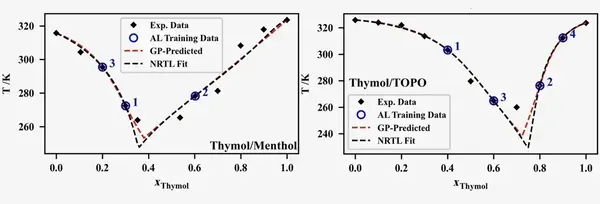
Predicting how mixtures behave, their phase diagrams and the activity coefficients that govern them, places a strong demand on a model; the predictions must be consistent with the laws of thermodynamics. We have developed Gaussian-process methods for activity coefficients in which the physics is built into the structure of the model rather than added afterward. The models are trained in a form that guarantees physically valid predictions and that enforces the known limiting behavior of a pure component, and they are verified after training to be thermodynamically consistent. Because a Gaussian process also estimates its own uncertainty, this uncertainty can be propagated through the thermodynamic relations that define vapor-liquid and solid-liquid equilibrium. That lets the model identify exactly which measurements or simulations would most improve a predicted phase diagram, often reducing the data needed to construct one from many points to only a few.
Abranches, Maginn & Colón, AIChE J. 2023, 69, e18141.
Physics-Aware Active Learning for Property Acquisition
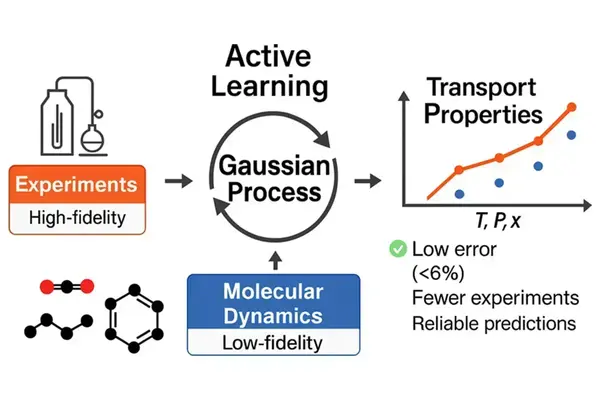
Reliable thermophysical data, whether from experiment or simulation, is expensive to obtain. Active learning addresses this by letting a model with calibrated uncertainty choose which measurement or calculation to perform next, rather than sampling blindly. We have used this idea to construct phase diagrams from a handful of well-chosen data points, and to combine cheap and expensive sources of data in a single multi-fidelity model, for example pairing fast molecular dynamics estimates with selective experiments to predict transport properties in CO2-hydrocarbon systems, and combining high-throughput experiments with simulation to characterize deep eutectic solvents. What makes this physics-aware rather than generic is that the choice of what to sample next is informed by the underlying thermodynamics, so the model spends its limited budget where the physics says the information matters most. This connects directly to the group's work on charged fluids, where the same active-learning ideas are applied to map the phase behavior of deep eutectic solvents (see Charged Fluids).
Abranches, Maginn & Colón, AIChE J. 2023, 69, e18141; Correa, Marin-Rimoldi, Maginn & Tavares, Ind. Eng. Chem. Res. 2025, 64, 23723; Abranches, Dean, Muñoz, Wang, Liang, Gurkan, Maginn & Colón, ACS Sustainable Chem. Eng. 2024, 12, 14218.
Funding
This work has been supported by the National Science Foundation, Air Force Office of Scientific Research, and the Department of Energy.